
The Fire Within: Understanding Anger Through the Lens of Chinese Medicine
We live in an angry world. You can feel it — in traffic, in conversations, in the low hum of tension that seems to follow you from morning to night. But what if that anger wasn't just a mood problem? What if it was a message from your body?
Traditional Chinese Medicine (TCM) has been asking this question for over two thousand years — long before modern science had words like "cortisol" or "amygdala." And the answers found within TCM theory are not only profound, they're remarkably consistent with what neuroscience is now discovering about how anger lives in the body, rewires the brain, and quietly disrupts nearly every system it touches.
This isn't a post about calming down or thinking positive thoughts. It's an invitation to understand anger at a deeper level — where it comes from, what it's doing to your body, and how the ancient tools of TCM (Traditional Chinese Medicine) can help you move through it, rather than being moved by it.
Meet Your Liver — The Organ of Anger
In TCM, every organ is more than a physical structure. Each one has an emotional life, a season, a direction of energy. The Liver — known as the General of the organs — is the home of anger in all its forms: frustration, resentment, irritability; the slow burn of unexpressed emotion, the sharp flash of rage. The Liver's primary job is to ensure the smooth, free flow of Qi (pronounced "chee") — the vital life energy that circulates through everything in your body. When Qi flows freely, you feel emotionally resilient, physically well, and mentally clear. When it gets stuck — which is exactly what anger does when it's not processed — the whole system begins to suffer. Learn more about the relationship between springtime, the Liver, and the smooth flow (or stagnation) of Liver qi.
In TCM, this stuck energy is called Liver Qi Stagnation, and it is one of the most common patterns seen in practice today. Modern life is practically a recipe for it. Here is what makes this relationship so important to understand:
Anger damages the Liver, and a strained Liver creates more anger. The relationship runs both ways — which is why the pattern can feel so inescapable. You're not weak or broken. You are caught in a loop that has a biological and energetic explanation, and a clear path forward.
A few key things to know about how TCM understands anger in the body:
The Liver governs free flow. When Qi moves freely, emotions arise and pass like weather. When it stagnates, they accumulate — becoming moods, then patterns, then illness.Anger is bidirectional. Emotional strain injures the Liver, and a Liver under strain amplifies emotional reactivity. This is why addressing the root matters more than managing the symptoms.Liver energy rises. TCM says anger drives energy upward — heat rushes to the face, head, and neck. This is the ancient description of what neuroscience now calls a stress hormone surge. Two traditions, one observation.The Liver opens to the eyes. Red, dry, or irritated eyes; tension headaches behind the eyes — these are classic signs that Liver energy is under strain.
The antidote to anger in TCM is not suppression — suppression makes stagnation worse. It is the cultivation of its opposite virtue: kindness, benevolence, the generous outward flow of energy. Where anger contracts and blocks, kindness opens and moves. The Liver, when healthy, is not the organ of rage. It is the organ of courageous, purposeful action in service of life.
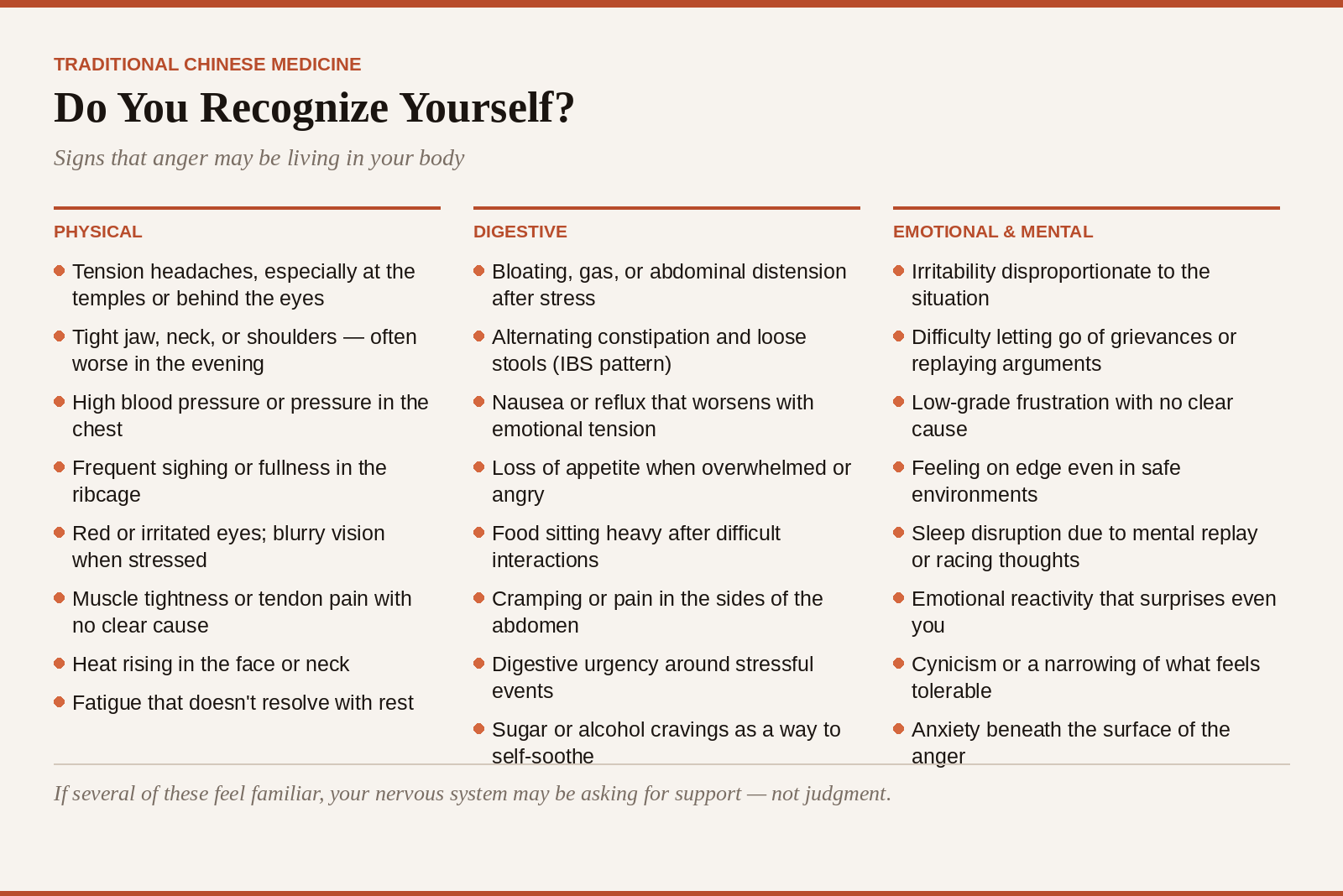
When anger has the better of us, we often don’t recognize ourselves. . Anger can come from nowhere and linger in the background of our daily intereactions. These symptoms span both TCM patterns and modern stress physiology. You don't need to have all of them. Even a cluster pointing in one direction is worth paying attention to. If several of these feel familiar, your nervous system may be running on a pattern of chronic activation. Your body is asking for support, not judgment. Use this symptom list for quick reference to determine if anger may be at the root of not knowing your own self.
Anger in Your Nervous System
Here is where ancient wisdom and modern science speak the same language in different dialects. At the heart of the anger response is the amygdala — the brain's alarm center. When it perceives a threat (real or symbolic), it floods the body with stress hormones: adrenaline for immediate readiness, cortisol for sustained vigilance. Heart rate rises. Blood pressure climbs. Muscles brace. Most critically, the prefrontal cortex — your capacity for reasoning, perspective, and conscious choice — partially goes offline. You feel certain, urgent, and right. You are, neurologically, running on older, more primitive software.
In TCM terms, this is Liver Yang Rising — the fire moving upward, overwhelming the system's capacity for clear-headed action. The body doesn't distinguish between a physical threat and an emotionally charged email. It responds the same way.
With chronic anger, this pattern becomes structural. The amygdala grows more sensitive with repeated activation. The brake circuit between the prefrontal cortex and the amygdala weakens. What began as an occasional reaction becomes a baseline state — a nervous system tuned for threat, even in its absence. This is not a character flaw. It is neurobiology, and it is changeable.
The Gut-Anger Connection
TCM has always understood that the Liver and the digestive system are deeply intertwined. When Liver Qi stagnates, it "invades" the Spleen and Stomach — disrupting digestion, creating bloating, cramping, and the kind of irritable bowel pattern that no amount of dietary adjustment fully resolves on its own. Modern gastroenterology confirms this through what is now called the gut-brain axis. The digestive system has its own nervous system — the enteric nervous system — in constant two-way communication with the brain. Stress and anger directly alter gut motility, change the composition of the gut microbiome, increase intestinal permeability, and suppress digestive enzyme production.
Roughly 90% of the body's serotonin — the neurotransmitter most associated with mood and emotional stability — is produced in the gut. A gut under chronic stress produces less of it. Which means digestive disruption and emotional dysregulation feed each other in a loop that is physiological, not merely psychological. This is why treating anger in TCM always includes attention to the digestive system. And it is why so many people find that addressing their emotional patterns resolves gut symptoms that nothing else could touch.
How Acupuncture Helps Restore the Smooth Flow
Acupuncture is not simply a relaxation technique — though relaxation is often one of its effects. It is a sophisticated system of working with the body's own regulatory intelligence: signaling the nervous system to downshift, encouraging Qi to move where it has become blocked, and supporting the organ systems that bear the burden of chronic emotional stress.
From a modern physiological standpoint, acupuncture has been shown to modulate the HPA axis (the stress hormone system), increase vagal tone (the parasympathetic "rest and digest" signal), reduce inflammatory markers, and shift the autonomic nervous system away from fight-or-flight. From a TCM standpoint, it moves stagnant Liver Qi, clears heat, nourishes the Blood, and restores the free flow that anger has disrupted. These different languages point to the same mechanism.
Three Ways Acupuncture Supports You
Regulating the nervous system: Acupuncture activates the parasympathetic nervous system — reducing circulating cortisol and adrenaline, lowering heart rate and blood pressure, and creating the physiological conditions in which the prefrontal cortex can come back online. The body moves from threat-response to restoration. Many patients describe a quality of calm after treatment that is distinct from simply feeling tired — it is a deep, systemic settling.Moving Liver Qi stagnation: Specific acupuncture points along the Liver and Gallbladder meridians gently encourage stuck energy to move. Patients often describe a profound shift during or after treatment — a sense of release, of space, of something loosening that they didn't realize was clenched. This is the experience of Qi moving where it was blocked. Over a course of treatment, these moments of release accumulate into lasting change.Supporting digestive harmony: By addressing the Liver-Spleen relationship, acupuncture helps restore healthy digestive function — reducing bloating, improving motility, and calming the gut-brain axis. When the digestive system settles, emotional regulation often improves with it. Because, as TCM has always known, these systems are never truly separate.
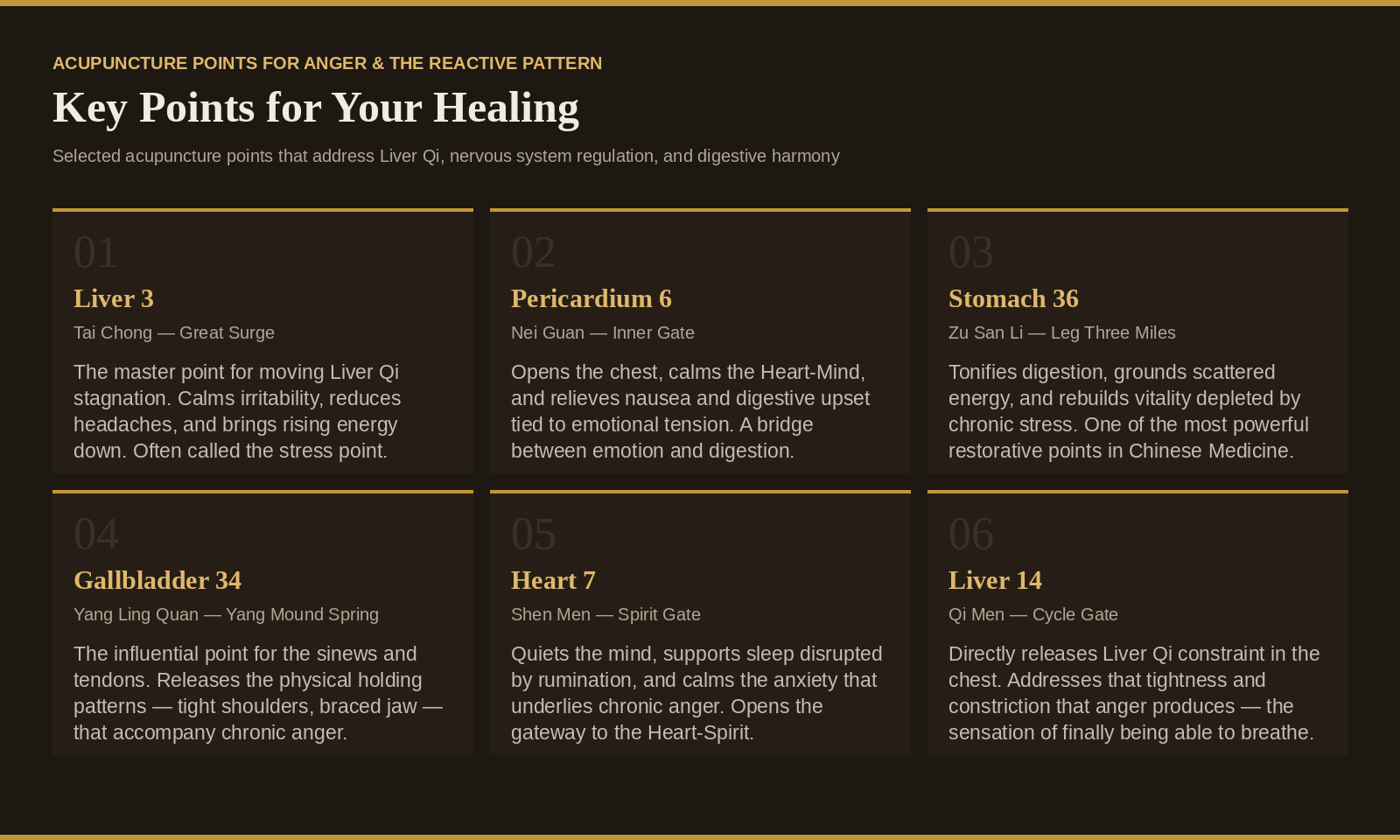
These are key acupuncture points most commonly used when working with anger, Liver Qi stagnation, and the reactive nervous system pattern. These points are regularly applied during an acupuncture treatment and may be massaged to stimulate the smooth flow of Qi through the body; calming the entire being.
Moving Beyond the Reactive Pattern
Acupuncture is not a one-session fix, and anger — especially the chronic kind — is not a problem to be eliminated but an energy to be understood and redirected. The goal of treatment is not to make you feel nothing. It is to create enough space between stimulus and response that you can choose how to act, rather than simply react. The process tends to unfold in a consistent direction across a course of treatment.
The nervous system begins to settle. Often within the first few sessions, patients notice they are sleeping more deeply, feel less reactive in ordinary moments, and that familiar tension in the jaw and shoulders has softened. The body is beginning to trust that it can rest. Healing begins to feel safe.
Digestive patterns begin to normalize. As Liver Qi moves more freely and the stress response quiets, the gut-brain axis settles. Bloating reduces. Bowel patterns regularize. The connection between emotional state and digestive health becomes unmistakably clear — often for the first time.
Emotional texture becomes richer. As the anger layer releases, what was underneath it often becomes accessible — grief, longing, creativity, purpose. Patients frequently describe reconnecting with parts of themselves they had forgotten. This is the Liver doing what it does best when healthy: seeing clearly and moving freely.
The gap between trigger and response widens. Where there used to be a hair-trigger, there is now a moment — a breath, a recognition, a choice. That gap is everything. It is where your agency lives.
Ready to Begin?
If you recognized yourself in these pages — in the symptoms, the patterns, the quiet exhaustion of carrying so much tension — you don't have to keep navigating it alone. Acupuncture offers a path that honors both the ancient wisdom of Eastern Medicine and the lived reality of your nervous system today. Each treatment is tailored to you — your unique pattern, your history, your body's particular way of holding what it has been asked to carry.
The first step is simply a conversation. We offer a Complimentary Free Consultation to align your needs with one of our skilled rpactitioners; addressing any question you have about acupuncture and the services we offer.
The Initial Intake process includes a full medical intake, diagnositcs, a treatment, and treatment plan.