
The Rising of Wood: Spring & the Liver's Awakening
Traditional Chinese Medicine & the Seasonal Cycle
In Traditional Chinese Medicine, we do not merely observe the seasons outside our windows. We live inside them. The body is a microcosm of the natural world, and as the earth shifts from the deep stillness of winter into the reaching energy of spring, so too must our inner landscape make that same passage. With spring arrived our energy begins to awaken from the depth of winter consolidation. Like seeds held in cold ground, our vital energy (Qi) contracts toward the core.
Spring proclaims that the earth cannot stay still forever, WE cannot stay still forever. As daylight lengthens and temperatures shift and slowly warm, the energy of our focus and motivation, too, begins to shift. Like sprouting tree buds, we ascend.
In TCM Spring is associsted with the element of Wood — dynamic, directional, and hungry for growth. And in this transition lies one of TCM's most illuminating teachings about what it means to be a body moving through time.
Wood (Spring) governs the Liver and Gallbladder. Its quality is rising, expanding, and flexible. Its movement is upward and outward, its shadow emotion anger — and in balance, clear vision and purpose. Qi becomes activated and moving, and the season calls us toward growth and new beginnings.
Flexibility or Stagnation — Wood's Two Faces
Think of young bamboo bending in wind — this is Wood in its ideal expression. Bamboo does not resist; it yields, then returns upright. Wood energy governs our capacity for this same quality: to be rooted enough to have direction, yet supple enough to bend without breaking; to acclimate to change and continue to move forward in a clear direction.
The Liver is the organ most associated with the Wood element, and its chief job is to ensure the smooth and free flow of Qi throughout the body. It is, in TCM terms, the great orchestrator — regulating movement, emotion, digestion, the menstrual cycle, and the tendons and sinews that allow physical flexibility. The Liver is like a general of an army — it governs strategy, planning, and the smooth movement of resources toward their goal. When the general is frustrated, nothing moves freely.
When Wood energy is healthy, there is a sense of ease in both body and mind: creativity flows, decisions come clearly, emotions move through rather than getting stuck. The Wood person in balance possesses vision, the ability to plan, a warm assertiveness, and a body that moves with suppleness.
When Wood stagnates — which is the particular vulnerability of spring, and of anyone who carried too much tension through winter — a very different picture emerges.
Liver Qi Stagnation
Liver Qi Stagnation is one of the most common TCM diagnoses in modern life, and spring — with its push toward movement and growth — tends to surface what has been frozen or suppressed over the winter months. Stress, repressed emotion, sedentary habits, and irregular eating all contribute to this pattern.
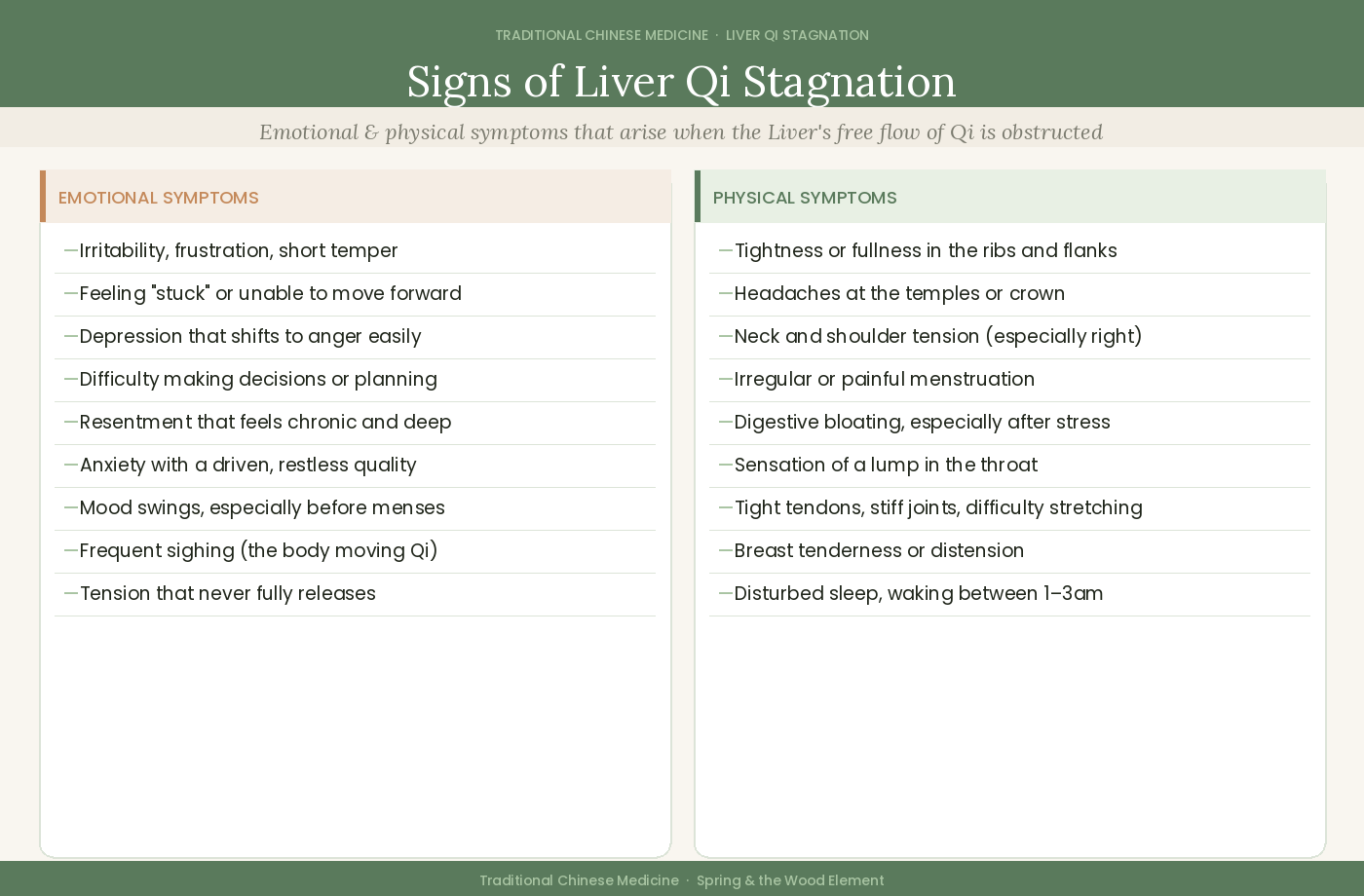
Notice that many of these symptoms share a quality of pressure without release — this is the hallmark of stagnation. The Liver's Qi is trying to rise and move outward with the season, but something is blocking it. Spring intensifies this pattern, which is why some people feel strangely worse as the weather improves.
The Winter's Residue — Phlegm and Dampness
In TCM, "Phlegm" means more than what you blow into a tissue. It refers to any sticky, sluggish accumulation in the body that builds up when our digestive system can't fully process what we take in. A sedentary winter of sitting, eating heavier foods, and spending less time outdoors is the perfect recipe for this kind of buildup. It can show up as sinus congestion, bloating, brain fog, puffy limbs, or that heavy, slow feeling that lingers even after a full night's sleep.
When spring arrives, the body naturally tries to push this residue out — but if your digestion is already sluggish, that clearing process needs a little help. Boosting the movement of qi with regular activity effectively aids the body in transtioning from winter into springtime activity. This is one of the key reasons people come in for acupuncture at the change of seasons. For a deeper look at how Phlegm accumulates and what to do about it, [read more here].
How Acupuncture Moves the Transition
This is where acupuncture offers something profound: it does not force the body into a new season — it assists the body's own intelligence in completing the transition. Think of a river in early spring where ice has partially melted. The water wants to flow; acupuncture clears the last blockages, opens the channels, and trusts the current to do the rest.
In clinical practice, spring treatments focus on three primary goals: moving stagnant Liver Qi, resolving accumulated Phlegm and Dampness, and supporting the Yang energy that needs to rise from the Kidneys upward through the system.
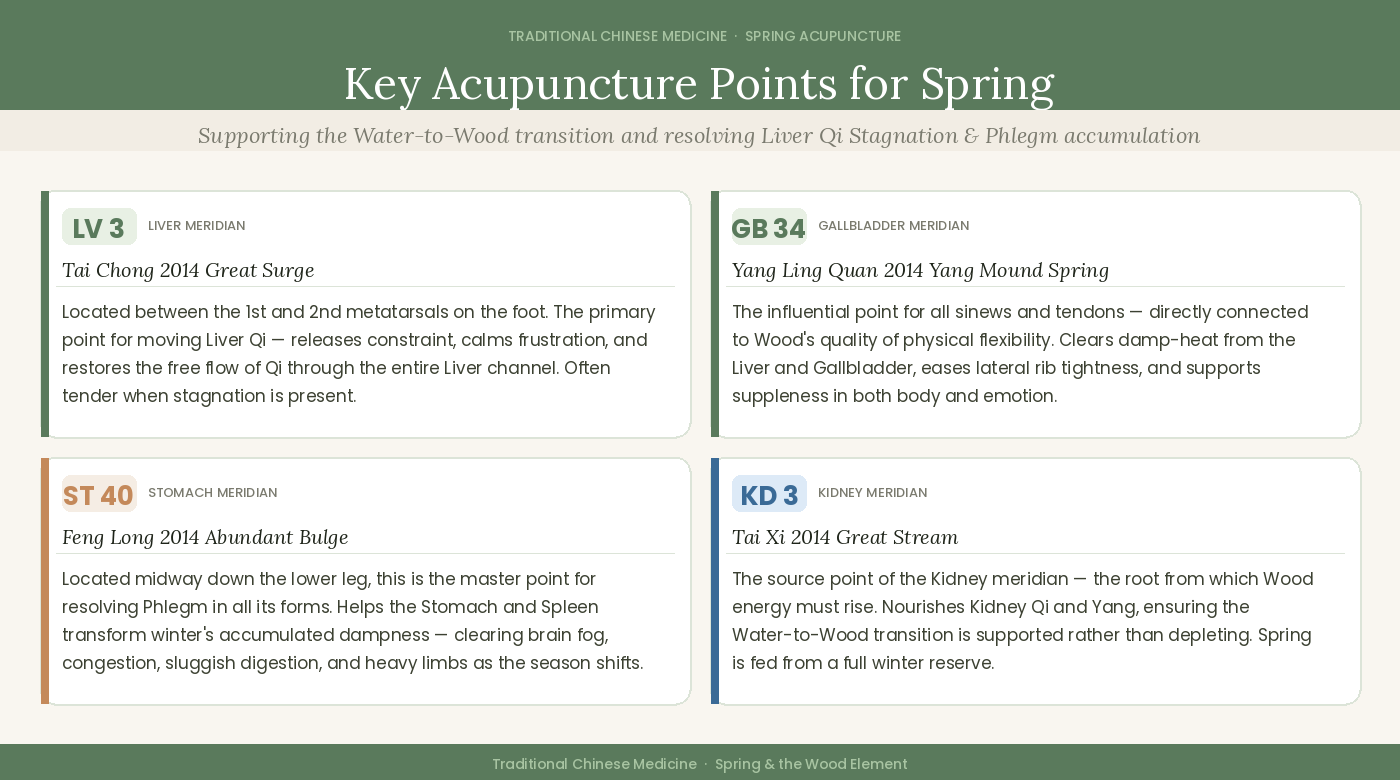
Points are chosen by a skilled practitioner reading the specific pattern of each individual — where Qi is most blocked, which organs need support, whether the presentation leans more toward stagnation, deficiency, or damp accumulation. The spring treatment course becomes a recalibration, preparing the body and spirit for the creative, outward energy that the Wood season demands.
Supporting the Transition at Home
Acupuncture works most powerfully alongside seasonal lifestyle practices. Moving the body daily — especially in the morning when Yang Qi naturally rises — is one of the most direct ways to assist the Liver. Gentle stretching, walking, or qigong done in the morning works with the body's own Wood-time energy to clear stagnation.
Spring is traditionally the time in Chinese medicine to introduce sour foods (the taste of the Liver), lightly cooked greens, and sprouted grains that support upward, growing energy; and to reduce heavy, oily, and sweet foods that encouraged Phlegm formation in winter. This is the season to do less cooking and make the gradual shift to more fresh fruits and vegetables al dante and raw!
Emotionally, the Wood season asks something of us that can be genuinely difficult: it asks us to want things again. To make plans. To lean toward the future with intention. For those who spent the winter in genuine stillness, this comes naturally. For those who spent it in suppression, stagnation, or exhaustion, spring can feel more like pressure than invitation — and that is exactly when the needle finds its purpose. The Wood element teaches us that flexibility and rootedness are not opposites — they are companions. The tree that survives the storm is not the one that stood rigid, nor the one with no roots at all. It is the one that bends, holds, and in the stillness after the wind, rises again toward light.
If you’d like to learn more about how Acupuncture and TCM can beenfit your spring transition to health, please schedule a consultaion and we’re happy to answer all of your questions and see how we may best benefit your health goals.